
What you will leave with
- 1. A strong Upwork proposal focuses on the client's problem rather than the freelancer's résumé.
- 2. A specific detail from the job post makes your proposal more relevant.
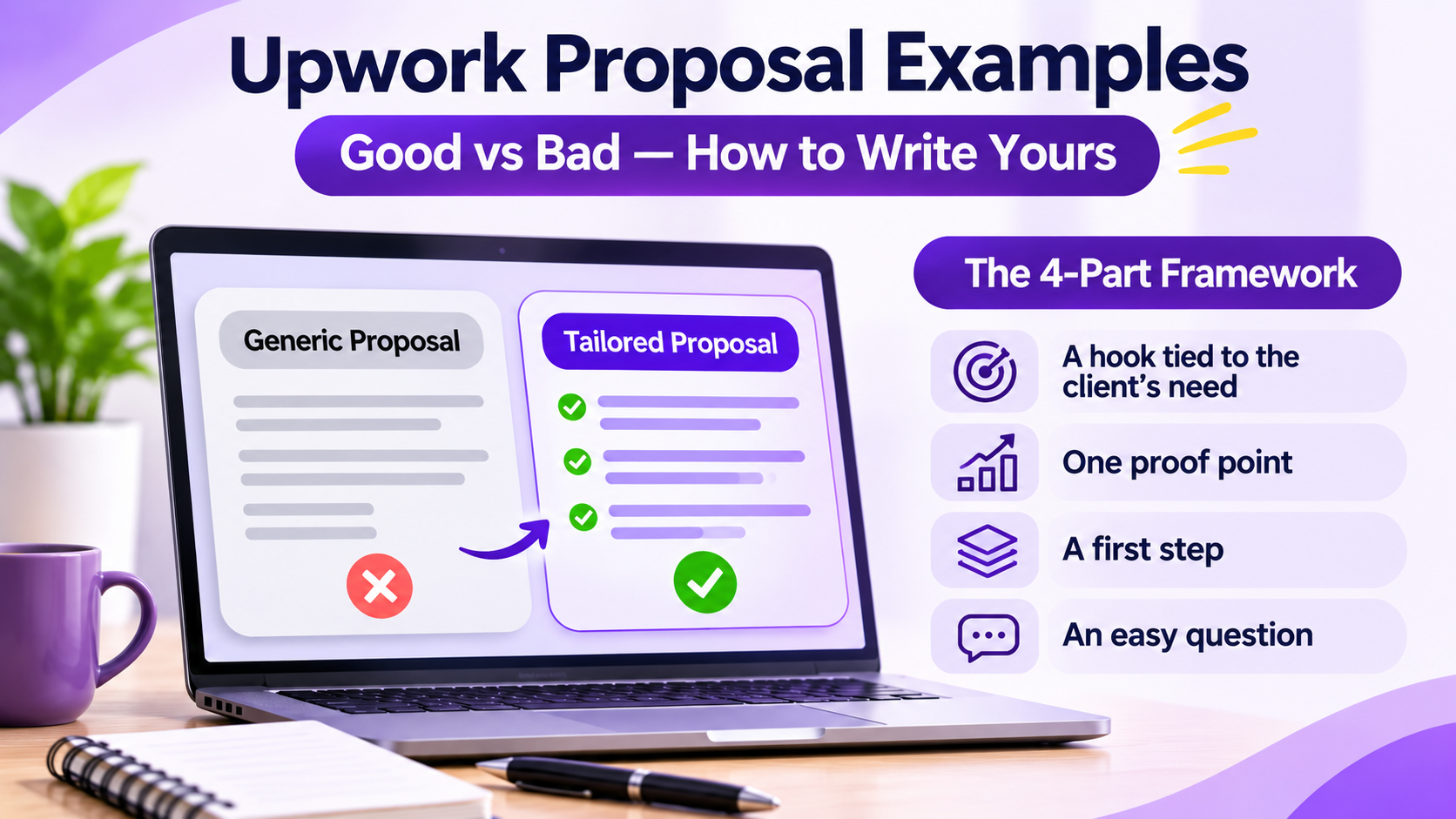
- 3. Use a four-part framework: a relevant hook, one proof point, a first step, and an easy next step.
- 4. Keep proposals concise, generally around 100–200 words.
- 5. End with one simple question that encourages the client to reply.
- 6. Learn from weak and strong proposal examples, but adapt the approach to each job instead of copying exact wording.
Introduction
The fastest way to learn how to write an effective Upwork proposal is to compare good and bad examples side by side. Many proposals fail because they focus too much on the freelancer, use generic language, and give the client no clear reason to reply. Strong proposals take a different approach. They focus on the client's problem, include specific details from the job description, demonstrate relevant experience, and make it easy for the client to respond. In this guide, we will break down real-world Upwork proposal examples, explain why weak versions fail, and show how stronger versions work. You will also learn a simple four-part framework that you can use to write better proposals for your own freelance projects.
The 4-Part Anatomy of a Proposal That Works
Almost every strong Upwork proposal follows four important steps in a specific order. These elements help you capture the client's attention, demonstrate your value, reduce the risk of hiring you, and encourage a response. Keep this framework in mind as you explore the examples in this guide.
1. A Hook Tied to the Job
Start your proposal with a specific detail from the job description, such as the tool the client uses, their goal, deadline, or biggest challenge. This shows that you have carefully read the job post instead of sending a generic application.
2. One Proof Point
Include one concrete result that demonstrates your ability to deliver the required work. For example, saying that you reduced mobile customer drop-off by 30% is more convincing than simply claiming to be experienced and reliable. A specific result provides stronger evidence of your skills.
3. A First Step
Explain briefly how you would begin the project. Suggesting an initial task, sharing a short plan, or offering a relevant sample can reduce the client's uncertainty and make it easier for them to consider hiring you.
4. An Easy Next Step
Finish your proposal with one simple question or an offer to share a sample. Give the client something specific and easy to respond to instead of ending with a generic statement such as "I look forward to hearing from you."
Example 1 — The Opening Line
The first one or two lines are all the client sees before deciding whether to keep reading. A strong opening can capture attention, while a generic introduction can cause the client to skip the rest of your proposal.
Weak Version
Dear Hiring Manager, I am writing to express my interest in your job posting. I am a hardworking and detail-oriented professional with over 10 years of experience, and I believe I would be the perfect fit for this role.
Why It Fails
Every word is about the freelancer, not the client. The introduction is generic enough to be pasted into almost any job application. It does not prove that the freelancer has read the specific job description or understands the client's requirements.
Strong Version
Hi Sarah — you mentioned your Shopify store is losing mobile customers at checkout. That's the exact problem I fixed for a fashion brand last month, cutting their mobile drop-off by about 30%.
Why It Wins
The opening mentions a specific detail from the job post and connects it to a concrete result. It immediately shows the client that the freelancer understands the problem and has relevant experience solving it. This gives the client a reason to continue reading.
Example 2 — A Standard Job (Full Proposal)
The opening line is important, but the entire proposal must also demonstrate relevance, experience, and a clear plan. Here is how a weak proposal compares with a stronger version for a standard freelance project.
Weak Version
Hello, I saw your job and I am very interested. I have a lot of experience in this area and I am confident I can deliver high-quality work on time. I am a fast learner, hardworking, and dedicated. Please check my profile and portfolio. I look forward to working with you.
Why It Fails
This proposal uses a list of generic adjectives without providing specific details. It does not mention the client's requirements, show proof of relevant experience, explain a project plan, or give the client a clear reason to respond. It could be sent to almost any client for almost any job.
Strong Version
Hi Mark — you need a 12-article content batch on personal finance, written to rank. I write finance content that does exactly that; here's a recent piece that hit page one for its keyword: [link]. For your batch, I'd start with one sample article on your top keyword so you can judge the fit before committing the full 12. Quick question: is the goal more to rank, or to convert readers into sign-ups?
Why It Wins
This proposal follows all four parts of the framework. It starts with the client's specific requirement, provides a proof point with a link, suggests a low-risk first step, and ends with an easy question. It feels personalized because it directly addresses the client's project.
Example 3 — When You Have No Reviews Yet
Not having Upwork reviews does not mean you cannot write a strong proposal. The key is to demonstrate relevant work, show a clear plan, and reduce the client's risk.
Weak Version
I'm new to Upwork and don't have any reviews yet, but I'm a fast learner and very motivated. I would really appreciate it if you could give me a chance to prove myself.
Why It Fails
This proposal opens with a weakness, asks for charity, and offers no evidence of ability. It puts all the risk on the client instead of giving them a reason to trust the freelancer.
Strong Version
Hi Ana — I haven't taken an Upwork contract yet, but I've built three WordPress sites for local businesses in the past year. Here's one that matches what you're after: [link]. For your project, I'd start by mapping your pages and sending you a quick plan before building, so you see exactly what you're getting. Happy to do the first section as a paid test if that makes it easier to say yes.
Why It Wins
Real work outside Upwork still counts as proof. This proposal reduces risk with a clear first step and a paid test, without begging for a chance. It acknowledges the lack of Upwork reviews once, then shifts the focus to relevant experience.
Example 4 — A Technical / Development Job
Technical jobs reward specificity and risk reduction over buzzwords. Instead of listing every technology you know, show that you understand the client's actual technical challenge.
Weak Version
I am an expert full-stack developer skilled in React, Node.js, MongoDB, AWS, and many other technologies. I can build anything you need. I have done many similar projects. Let's connect.
Why It Fails
A list of skills is not proof of experience. Saying "I can build anything" sounds too general, and the proposal does not address the client's actual technical requirements or explain how the work will be handled.
Strong Version
Hi Dev team — I've built the kind of Stripe-subscription flow you're describing, including the webhook handling that usually causes the headaches. The trickiest part here is syncing failed payments back to user access, so I'd de-risk that first with a short spec we both sign off on before I write code. Recent example: [link]. What's powering your current backend?
Why It Wins
This proposal identifies a specific technical requirement, highlights a potential risk, and explains how to address it. It also provides a relevant example and ends with a technical question that makes it easy for the client to reply.
Example 5 — The Closing Line
How you end your proposal can determine whether the client has a reason to reply. A strong closing line should make the next step easy and encourage a conversation.
Weak Version
Thank you for your time and consideration. I look forward to hearing from you soon.
Why It Fails
This closing is polite but empty. It gives the client nothing specific to respond to and does not encourage a meaningful next step.
Strong Version
One quick question: is the API already built, or would that be part of the scope? Either way, I can start this week.
Why It Wins
One easy question invites a reply while showing that you are ready to begin. A clear question gives the client a reason to respond, making it more effective than a generic polite sign-off.
The Pattern Across Every Example
Across all the examples, the same principles appear repeatedly. Strong proposals are not about using complicated language or writing long introductions. They focus on making the client's decision easier.
Client First, Not You
Start with the client's problem, goal, or requirement instead of opening with your background or résumé.
Specific Beats Generic
Mention one detail from the job post and connect it to relevant experience. Specific details make your proposal feel personal rather than copied.
Lower the Risk
Suggest a clear first step that helps the client understand your approach before committing to the full project.
Give Them Something to Reply To
End with one relevant, easy-to-answer question instead of a generic closing line.
Keep It Short
Every strong version in these examples is under roughly 120 words. Clients often skim proposals on mobile, so keep your message focused and remove anything that does not add value.
Common Mistakes These Examples Avoid
Even experienced freelancers can make simple proposal mistakes that reduce their chances of getting replies. Avoid these common habits when writing your next Upwork proposal.
Opening With Your resume
Starting with your skills, experience, or career history instead of the client's problem makes your proposal feel less relevant.
Sending the Same Proposal Everywhere
Identical proposals can look automated and fail to address what each client actually needs. Personalize every bid with details from the job post.
Writing a Wall of Text
Long paragraphs are difficult to scan, especially on a phone. Keep your proposal concise and make the important details easy to find.
Using Vague Proof
Saying you have "lots of experience" does not demonstrate your ability. Use a relevant example, specific result, or portfolio link instead.
Ending Without a Clear Next Step
A generic closing gives the client no reason to respond. End with one simple question related to the project.
Begging for a Chance
Avoid asking clients to give you a chance. Instead, show relevant evidence and explain how you can reduce the risk of working with you.
How to Write Yours in Four Steps
Use this simple four-step process to turn the principles from these examples into a personalized Upwork proposal for your next job.
Step 1: Read the Job Post Twice
Identify one specific detail you can use in your opening line and one important requirement you need to address first. This helps you focus on what matters most to the client.
Step 2: Write a Client-Focused Hook
Build your opening around the detail you identified. Make the first line about the client's goal or problem, not your own background.
Step 3: Add One Relevant Proof Point
Include one example that relates directly to the outcome the client wants. Add a portfolio link if you have one, so the client can quickly verify your experience.
Step 4: Close With a Question and a First Step
End with one easy-to-answer question and briefly explain what you would do first. Then edit your proposal down to roughly 100–150 words, removing anything unnecessary. Want more inspiration? Explore our Upwork proposal samples and templates for additional examples, review our guide to writing effective Upwork opening lines, and read the Upwork Connects guide to understand how to use your Connects strategically.
Frequently Asked Questions
What Does a Good Upwork Proposal Look Like?
A good Upwork.com proposal opens with a specific detail from the job post, backs it with one concrete result, notes how you'd start, and ends with an easy question — all in roughly 100–200 words. It's written for that one client and leads with their problem, not your background. The strong versions in the examples above all follow this shape. upwork.com
How Do You Start an Upwork Proposal?
Start with the client's problem or goal, using a real detail from their post — the tool, the deadline, the outcome they want. Skip "Dear Hiring Manager" and skip the list of credentials. Your first line should make the client think "this person read my job," because that's what earns the rest of their attention.
How Long Should an Upwork Proposal Be?
Most winning proposals are 100–200 words — shorter for simple jobs, slightly longer for complex ones that need a real plan. What matters more than length is that the first two lines prove you read the post. Long, generic proposals get skimmed past. upwork.com
How Do I Write an Upwork Proposal With No Experience?
Lead with relevant real work even if it's not from Upwork.com — a portfolio piece, a prior role, or a personal project — and show you understood the specific job. Lower the client's risk with a tight first milestone or a small paid test, so they judge your work rather than your empty review history. Don't open with "I'm new" or ask for a chance.
Why Do My Upwork Proposals Get No Replies?
Usually because they're generic, me-focused, or end with a dead-end sign-off. Sharpen the first two lines so they reference the client's specific problem, back the pitch with one concrete result, keep it short, and close with one easy question. Then be selective about which jobs you bid on — a great proposal on a well-matched job beats a boosted one on a job you're only half-suited for. Upwork.com
Conclusion: Write Proposals That Get Replies
If writing a tailored proposal for every job is eating your time, BidNinjas reads the job post and drafts a scored, personalized proposal in about three minutes — built on exactly the good-example pattern above. Free to start, no card required.
Good and bad Upwork proposals aren't separated by talent or experience — they're separated by a few habits you can copy today. Lead with the client, prove it with one specific detail, make it easy to say yes, and end with a question. Do that on every bid and your reply rate climbs.
Write Stronger Upwork Proposals With BidNinjas
Write stronger Upwork proposals with BidNinjas → https://bidninjas.ai/ On Upwork - upwork.com