What you will leave with
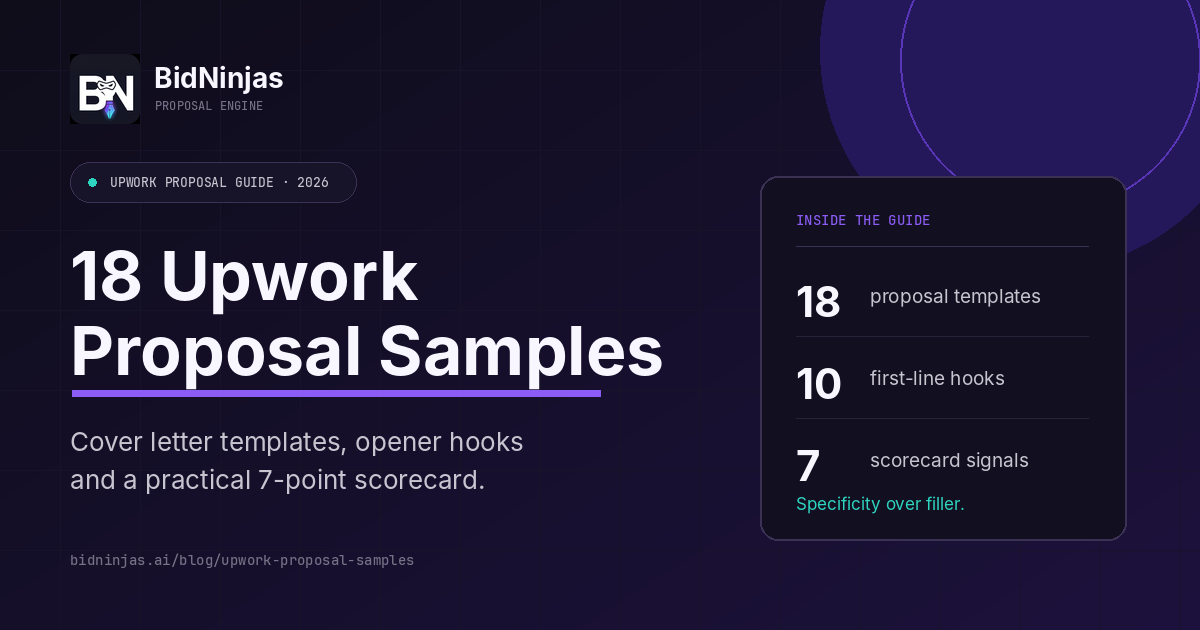
- Structure each proposal around a job-specific hook, one relevant proof point, a first-step plan, and one easy next step.
- Use the 18 samples as starting structures and replace every bracketed field with truthful job and profile details.
- Review each draft with the seven-point scorecard before spending Connects; the score is a quality-control check, not an outcome prediction.
- Treat boosting as optional visibility for selected exact-fit jobs, not as a substitute for relevance or personalization.
A winning Upwork proposal is a short, tailored pitch — usually 100 to 200 words — that proves in the first two lines you read the job post, backs it with one concrete result, and makes it effortless for the client to reply. It is not a mini-resume. Clients may review many proposals quickly, so a useful opening leads with the client's problem instead of the freelancer's life story.
This guide gives you 18 Upwork proposal samples sorted by situation and niche, a self-scoring checklist you can run on any draft in 60 seconds, a swipe file of openers, and the part most template posts skip: how boosting and Connects actually fit into getting seen in 2026. Copy what fits, swap in a real detail, and send.
Key takeaways
- A winning Upwork proposal follows a simple four-part shape: a hook tied to the job post, one proof point, a first-step plan, and a low-friction next step.
- Personalization beats length. One specific detail from the client's post is more useful than three paragraphs of generic credentials.
- Keep most proposals in the 100–200 word band. Keep the proposal easy to scan on mobile.
- Boosting can raise your placement, but it never fixes a weak proposal — job fit and the opening lines remain important.
What makes an Upwork proposal actually win
Before the templates, review the structure they share. For a complete walkthrough, use this seven-step Upwork proposal guide. The practical framework has four parts:
- 01A hook that references the job. Open with a specific detail from the post — the tool, the deliverable, the deadline, the audience, or the pain point. Skip "I'm applying for..." and skip the wall of credentials. Your first one or two lines are all the client sees before deciding to keep reading.
- 02One proof point tied to the same outcome. "I'm experienced" is noise. "I migrated a 4,000-product Shopify store with zero downtime" is signal. One relevant, concrete result beats a list every time.
- 03A first-step plan. Clients hire to reduce risk. A quick note on how you'd start, what you'd deliver first, and how you'll communicate lowers the perceived risk of picking you.
- 04A low-friction next step. End with something easy to say yes to: one clarifying question, an offer to share a relevant sample, or a suggested quick call. One ask, no pressure.
Everything below is built on that spine. The samples change the wording and the niche; the skeleton stays the same.
The Winning Proposal Scorecard
Here is the part you can't copy from anyone else: a quick rubric to grade a proposal before you spend Connects on it. Run your draft against these seven elements and give yourself a point for each. Use six or seven as a strong quality-control signal, four or five as a prompt to revise, and three or below as a sign that key information is missing. This is an editorial checklist, not a prediction of replies or hires.
| # | Element | You earn the point if... |
|---|---|---|
| 1 | Job-specific hook | Your first sentence names a real detail from this post, not a generic greeting. |
| 2 | Client-first framing | The opening is about their problem or goal, not your bio. |
| 3 | One concrete proof | You cite a specific result, metric, deliverable, or named example. |
| 4 | Clear first step | You state what you'd do first or deliver first, so the start feels low-risk. |
| 5 | Right length | You're in the 100–200 word range (shorter for simple jobs), not a wall of text. |
| 6 | Skimmable format | Short paragraphs or a couple of line breaks; readable on a phone in five seconds. |
| 7 | Easy next step | You close with one question or offer that's simple to reply to. |
This is the same logic a scoring tool like BidNinjas applies automatically, but you can run it by hand. The point is to stop sending proposals on instinct and start sending ones you know are complete.
18 Upwork proposal samples
Use these as a starting point, then make each one real. A proposal that mentions "the Klaviyo flows" or "your 12-article content batch" reads as written for that project. A proposal that could be pasted onto any job reads as filler. Specificity is the whole game. Every sample below is short on purpose. Swap the brackets and keep the shape. You can also compare the six niche proposal examples and the reusable proposal template.
General-purpose openers
1. The problem-solution opener (Best for: most jobs where the client describes a clear pain point.)
Hi [Name], you mentioned [specific problem from the post] is slowing you down. I've solved exactly that for [type of client] — most recently [one-line result]. If it helps, my first step would be [first deliverable] so you see progress fast. Happy to share a similar example — want me to send it over?
2. The exact-fit specialist (Best for: jobs that call for a niche you own.)
Hi [Name], [niche] is the one thing I do all day — I've shipped [number] [projects] like this, including [named example]. Your requirement for [specific spec] is squarely in my lane. I can start with [first step] this week. One quick question: [scope-clarifying question]?
3. The question-first opener (Best for: postings that are slightly vague, where a sharp question shows expertise.)
Hi [Name], quick question before I say anything about me: is [specific detail] a hard requirement, or open to [alternative]? I ask because I've built [similar thing] and the answer changes how I'd approach [part of the project]. Either way, I've done this exact work — [one proof point] — and can map out a plan for you.
4. The value / ROI angle (Best for: business-outcome jobs — marketing, sales, ops.)
Hi [Name], the goal here reads as [business outcome, e.g. "more qualified demo bookings"], not just [surface task]. I focus on that outcome: for [past client] I [result with a number]. I'd start by [first step tied to the outcome], then measure against [metric]. Want to talk through what "good" looks like for you?
By experience level
5. New freelancer, no reviews yet (Best for: your first jobs, when you have skills but no Upwork history.)
Hi [Name], I'm newer to Upwork but not to [skill] — I've [relevant real experience: portfolio piece, prior role, personal project]. I read your post carefully and here's how I'd tackle [specific task]: [two-step approach]. To make this easy for you, I'm happy to [do a small paid test task / start with a tight first milestone] so you can judge the work, not the badge.
6. Switching niches (transferable proof) (Best for: pivoting into a new category with adjacent experience.)
Hi [Name], I've spent [time] doing [old niche], and the same skills — [transferable skill 1], [transferable skill 2] — are exactly what [new niche task] needs. For example, [result that transfers]. I'd start with [first step] to prove the fit quickly. Open to a short call to confirm I'm the right match?
Short vs. detailed
7. The ultra-short version (Best for: simple, well-defined tasks and mobile-skimming clients.)
Hi [Name] — I can do [specific deliverable] and have done it [number] times ([example]). I'd start today with [first step]. One question: [clarifier]? Samples ready if useful.
8. The detailed version (Best for: complex, higher-budget projects where the client wants a real plan.)
Hi [Name], thanks for the detailed brief on [project]. Here's how I read it and how I'd deliver:
- Understanding: the core goal is [outcome], with [constraint] as the tricky part.
- Approach: [step 1] → [step 2] → [step 3], starting with [first deliverable].
- Proof: I did this for [client] — [result].
- Communication: [cadence, e.g. "daily updates + a Loom at each milestone"].
If that lines up with what you had in mind, I can start [timeframe]. Anything you'd want me to prioritize first?
By niche (swap the specifics)
9. Web / software development (Best for: dev, API, and integration jobs.)
Hi [Name], I've built [similar system] with [stack], including [named integration]. Your note about [specific technical requirement] is the part I'd de-risk first — I'd start with [first technical step] and a short spec so we agree before I write code. Recent example: [result]. What's powering the current setup?
10. Design / creative (Best for: branding, UI, and visual work.)
Hi [Name], loved the direction in your brief — [specific detail]. I design for [outcome, e.g. "conversion, not just looks"] and recently did [named project + result]. I'd start with [first step, e.g. "two quick concept directions"] so you can react to something visual fast. Portfolio piece that matches this vibe is ready — want the link?
11. Writing / content (Best for: articles, copy, and content-batch jobs.)
Hi [Name], I write [content type] in the [niche] space and match voice fast — here's a piece close to what you need: [example]. For your [deliverable], I'd start with [first step, e.g. "one sample article on your top keyword"] so you can judge fit before committing the full batch. What's the primary goal — [rank / educate / convert]?
12. Virtual assistant / admin (Best for: VA, inbox, scheduling, and operations support.)
Hi [Name], I've supported [role/type of business] with exactly this — [tasks from the post]. I'm reliable on [tools mentioned] and would start by [first step, e.g. "mapping your current inbox rules and a daily checklist"]. I overlap [X hours] with your timezone. Want me to run a short trial week so you can see how I work?
13. Marketing / SEO / ads (Best for: growth, paid media, and SEO jobs.)
Hi [Name], the real goal here looks like [outcome, e.g. "lower cost per lead"], and that's what I optimize for. For [past client] I [result with a metric] in [timeframe]. I'd start with a quick audit of [specific channel/asset] and a prioritized list of the three highest-impact fixes. Can I take a look at your current [account/analytics]?
14. Video / motion (Best for: editing, animation, and video production.)
Hi [Name], I edit [video type] for [audience/platform] — here's a reel close to your style: [example]. For your [deliverable], I'd start with [first step, e.g. "a 15-second sample cut"] so you can check pacing and tone before I do the full edit. What's the target length and platform?
15. Data / analytics (Best for: dashboards, analysis, and data-cleanup jobs.)
Hi [Name], I turn messy [data source] into [clear output] — recently [named result, e.g. "a live sales dashboard that cut reporting from a day to minutes"]. Your requirement for [specific metric/tool] is straightforward for me. I'd start by [first step, e.g. "auditing the data and confirming the exact metrics you need"]. What tools are you in now?
Situational
16. The retainer / long-term pitch (Best for: when the post hints at ongoing work.)
Hi [Name], this reads like it could be ongoing rather than one-and-done, and that's how I work best — as a steady partner, not a one-time vendor. I've held [length] retainers doing [work], with [result]. I'd suggest starting with [first project] to build trust, then a simple monthly cadence. Open to talking about what a longer engagement could look like?
17. Replying to an invite (Best for: when a client invited you to a job.)
Hi [Name], thanks for the invite — I read the post and it's a strong fit. [One line on why, tied to a detail.] I've done [proof point], and I'd start with [first step]. To hit your brief exactly, one question: [clarifier]? Happy to jump on a quick call whenever suits you.
18. The polite follow-up (Best for: a proposal or interview that went quiet — send as a message, not a new bid.)
Hi [Name], following up on [project] — still keen and still have space for it. If it's helpful, here's [a relevant sample / a quick idea for your first deliverable] so you've got something concrete to react to. No pressure either way; just let me know if you'd like to move forward.
Bonus: 10 first-line hooks that stop the skim
The opener establishes relevance quickly. Pair these with the four-part structure above, then review the deeper guide to Upwork proposal opening lines.
- "You mentioned [problem] — that's the exact thing I fix for [type of client]."
- "Quick question before I pitch: is [detail] fixed, or flexible?"
- "The goal here looks like [outcome], not just [task]. Here's how I'd hit it."
- "I just did this — [one-line result] — for a client with the same [need]."
- "Three things I'd prioritize on [project], in order..."
- "Saw [specific detail] in your post; here's the first thing I'd change."
- "You need [deliverable] done right, not just done. Here's my proof."
- "I read the whole brief (I know that's rare). The tricky part is [X] — I've solved it before."
- "If [specific pain] is the reason you're posting this, I can help fast."
- "Skipping the resume — here's the one result that shows I can do this: [result]."
Never paste the same opener onto every job. Rotate, and always tie line one to the specific post.
Boosted Proposals and Connects: when to spend to get seen
Templates help you structure a proposal. Getting it seen is a separate question, and in 2026 that means understanding Connects and Boosted Proposals.
Every proposal you submit costs a number of Connects, and Upwork also lets you spend extra Connects to "boost" a proposal into a more prominent slot. According to Upwork's help documentation, boosting places your proposal near the top of the client's list, clearly marked. It works as a real-time auction: you set the maximum Connects you're willing to bid, and the highest bids take the top boosted spots. Upwork also notes the Connects required for a job can change while a post is live, and that boosting temporarily charges, refunds, then re-charges Connects as the bidding process settles.
The strategy that matters: boosting amplifies a strong proposal — it can't rescue a weak one. A boosted mediocre bid still loses to an un-boosted excellent bid from a well-matched freelancer; you've just paid more to be ignored near the top.
So boost selectively:
- Worth it: an exact-fit job, a high project value, and a proposal that already scores 6–7 on the checklist above. Spending a few extra Connects to get seen first on a $10k project you're perfect for is a reasonable bet.
- Skip it: marginal-fit jobs, vague postings, posts more than a few days old with high proposal counts, or clients with no verified payment method. Boosting there is spending money on visibility that won't convert.
If your un-boosted proposals rarely get viewed, the fix usually isn't more boosting — it's a sharper first two lines and better job targeting.
How to personalize a proposal in under 3 minutes
Time pressure is one reason freelancers fall back on generic proposals. A repeatable process makes personalization easier without adding a long drafting session. The fix is a fast, repeatable process:
- 01Read the post twice. Pull out one detail to open with and one requirement to address first.
- 02Pick the matching template from above and drop in the client's name and that detail.
- 03Swap in one proof point relevant to this outcome.
- 04Score it against the seven-point checklist. Fix anything under six.
- 05Decide on boosting using the rules above.
With your proof points ready, that loop can take about three minutes. BidNinjas drafts and scores a personalized proposal from the job post and your profile, then uses the outcomes you record to improve the context used in future drafts. Either way, the principle holds: every Connect you spend should sit behind a genuine, tailored proposal.
How to submit a proposal on Upwork (step by step)
If you're newer to the platform, these are the core mechanics from Upwork's proposal submission guide:
- 01Find the job in your feed or search and open the post.
- 02Click Apply Now (or Submit a Proposal).
- 03Set your rate or bid and your terms for the job.
- 04Write your cover letter — this is the proposal text the samples above are for.
- 05Answer any screening questions the client added. Use this screening-question guide when the client asks for additional written responses.
- 06Decide whether to boost, then submit. Connects are deducted when you submit.
With a relevant template and proof point ready, the submission process can be completed quickly.
Common mistakes that get proposals ignored
A few patterns worth avoiding:
- Opening with your resume. "I'm a senior developer with 10 years..." centers you, not the client. Lead with their problem.
- Sending the same proposal everywhere. Identical bids read as automated and convert badly. Thirty seconds of specificity beats a recycled paragraph.
- Writing a wall of text. Clients skim on mobile. Keep it tight and scannable, and put the important line first.
- Vague proof. "I have lots of experience" says nothing. One concrete result — a number, a named client, a deliverable — says everything.
- No next step. Ending with "Looking forward to hearing from you" gives the client nothing to do. Ask one easy question or offer a relevant sample.
- Boosting to compensate. Spending extra Connects to bury a weak proposal near the top wastes both the Connects and the opportunity.
Frequently Asked Questions
What should an Upwork proposal include?
Four things: a hook that references a specific detail from the job post, one concrete proof point tied to the same kind of outcome, a short note on your first step, and an easy next step like a clarifying question or an offer to share a sample. Keep it to roughly 100–200 words and lead with the client's problem, not your background.
How long should an Upwork proposal be?
A practical starting point is 100 to 200 words — shorter for simple, well-defined tasks and a bit longer for complex projects that need a real plan. What matters more than length is that the opening references the job clearly and the rest stays easy to scan.
How do I write an Upwork proposal with no experience?
Lead with relevant real experience even if it's not from Upwork — a portfolio piece, a prior role, or a personal project — and show you understood the specific task. Lower the client's risk by offering a small paid test task or a tight first milestone so they can judge the work rather than your review count.
Do Upwork proposals cost Connects?
Yes. Each proposal you submit deducts a number of Connects from your balance, and the amount can vary by job based on factors like project size and demand. Boosting a proposal costs extra Connects on top of that. Only spend them behind a genuinely tailored proposal.
Are Boosted Proposals worth it?
They can be, on exact-fit, high-value jobs where your proposal is already strong. Boosting improves visibility but does not fix poor job fit or a weak proposal, so it's usually not worth it on marginal or vague postings. Treat it as amplification for your best bids, not a default on every job.
Should I use a template for every Upwork proposal?
Use a template as a starting skeleton, then customize the hook, the proof point, and the first step for each job. Reusing the same untouched proposal removes the specificity that helps a client evaluate fit. Adapt every sample to the actual post before sending it.
How can I get more replies to my Upwork proposals?
Use the first two lines to reference the client's specific problem, add one truthful and relevant proof point, keep the proposal easy to scan, and close with a low-friction next step. Be selective about which jobs you bid on; boosting adds visibility but cannot create genuine job fit.
Your proposal is one of the main inputs a client uses to decide whether to continue the conversation. Save these templates, run the scorecard, and spend Connects only after the proposal reflects the actual job and your relevant proof.
When you would rather not run the five-step loop by hand every time, BidNinjas drafts and scores personalized Upwork proposals in about three minutes and uses the outcomes you record to improve future context. The Free plan includes three proposals per month and does not require a card.
Start free with BidNinjas →